
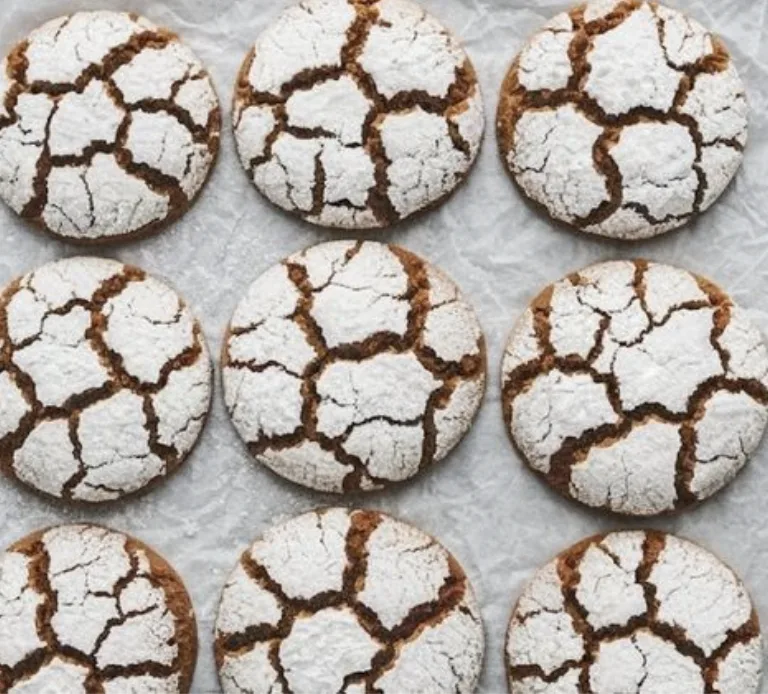
Gingerbread Crinkle Cookies are a delicious way to bring warm spices, rich molasses flavor, and a beautiful powdered sugar finish to your holiday baking. With their soft centers, slightly crisp edges, and distinctive cracked surfaces, these cookies look as wonderful as they taste. Every bite delivers the comforting flavors of gingerbread in a simple, easy-to-enjoy cookie.
Unlike traditional gingerbread cookies that are often rolled out and cut into festive shapes, gingerbread crinkle cookies are shaped into small dough balls and coated in powdered sugar before baking. As the cookies expand in the oven, their surfaces split naturally, revealing the darker brown cookie underneath and creating the classic crinkle pattern.
These cookies are perfect for Christmas cookie trays, holiday parties, homemade edible gifts, and cozy afternoons with a cup of coffee, tea, or hot chocolate. They are also a lovely option when you want a festive dessert without spending hours decorating individual cookies.
This article uses a published gingerbread crinkle cookie recipe as its basis. The photograph shows the finished cookies but does not provide an original ingredient list, so the measurements and instructions below follow a documented version from King Arthur Baking. Different gingerbread crinkle recipes use different proportions and baking times, so results may vary slightly depending on the formula you choose.
Why You’ll Love These Gingerbread Crinkle Cookies
There are plenty of reasons to add these cookies to your collection of favorite holiday treats. Their flavor, texture, and appearance make them a reliable choice for both casual baking and special occasions.
1. Warm Gingerbread Flavor
Ground ginger provides the signature spicy warmth, while molasses contributes a deep, rich sweetness. A gingerbread spice blend adds extra complexity, creating a flavor that feels cozy and festive without requiring a complicated list of ingredients.
The combination is especially appealing during the colder months, when warm spices are commonly used in cookies, cakes, and other homemade desserts.
2. Soft Centers and Chewy Texture
A good crinkle cookie should have a tender center rather than a hard, dry interior. These cookies develop a soft, slightly chewy texture when baked until the centers are set and the edges are firm.
Allowing them to cool properly is important because the cookies continue to settle after leaving the oven. Their final texture becomes more noticeable as they cool.
3. Beautiful Cracked Tops
The signature appearance is one of the best things about this recipe. Powdered sugar coats the outside of each dough ball, while the cookie expands during baking. The surface develops cracks that expose the darker dough underneath.
The contrast between white sugar and warm brown cookie creates an attractive finish without icing, sprinkles, or elaborate decoration.
4. Simple Preparation
You do not need cookie cutters, rolling pins, or piping bags. The dough is mixed in a bowl, chilled, shaped into balls, coated in powdered sugar, and baked on prepared baking sheets.
Although chilling requires some waiting time, the hands-on preparation is straightforward and manageable for home bakers.
5. Great for Holiday Sharing
Gingerbread crinkle cookies fit naturally into Christmas cookie boxes, dessert platters, potlucks, and family gatherings. Their attractive appearance makes them look special even when served without additional decorations.
They can also be arranged with other homemade cookies to create a varied holiday assortment.
Ingredients for Gingerbread Crinkle Cookies
The following ingredients are based on King Arthur Baking’s published gingerbread crinkle cookie recipe. This version makes approximately 15 cookies and includes a separate coating for the outside of the dough balls.
For the Cookie Dough
- 3/4 cup packed dark brown sugar: Adds sweetness, moisture, and a rich caramel-like flavor.
- 5 tablespoons unsalted butter, melted: Helps bring the dough together and contributes richness.
- 3 tablespoons molasses: Provides the deep, characteristic gingerbread taste and color.
- 1 teaspoon vanilla extract: Adds a rounded flavor that complements the spices.
- 1/2 teaspoon table salt: Balances the sweetness and enhances the other ingredients.
- 1 large egg, at room temperature: Helps bind the dough and contributes to its structure.
- 1 2/3 cups all-purpose flour: Forms the main structure of the cookies.
- 1 1/2 teaspoons gingerbread spice: Gives the cookies their warm, aromatic flavor.
- 1/2 teaspoon baking powder: Helps the cookies rise as they bake.
- 1/4 teaspoon baking soda: Works with the other ingredients to support the cookie texture.
For the Powdered Sugar Coating
- 1/2 cup confectioners’ sugar: Creates the snowy white coating and highlights the cracks.
- 3/4 teaspoon gingerbread spice: Adds an extra layer of spice to the outside of the cookies.
If you do not have a prepared gingerbread spice blend, the published recipe provides a homemade alternative: mix 1/2 teaspoon ground ginger, 1/2 teaspoon ground cinnamon, 1/2 teaspoon ground nutmeg, 1/2 teaspoon ground allspice, and 1/4 teaspoon ground cloves. Use 1 1/2 teaspoons of the mixture in the dough and the remaining 3/4 teaspoon in the coating.
Understanding the Key Ingredients
Molasses is one of the defining ingredients in gingerbread baking. It contributes a dark color, distinctive sweetness, and a deep flavor that pairs especially well with ginger and cinnamon. Use the type specified by your chosen recipe because different molasses products can have different levels of intensity.
Brown sugar helps create a moist, flavorful cookie. Packed brown sugar also brings a subtle caramel note that complements the molasses.
Gingerbread spice provides the recognizable flavor profile. If you are mixing your own spices, measure carefully so that the ginger, cinnamon, nutmeg, allspice, and cloves remain balanced.
Confectioners’ sugar is responsible for the attractive white finish. A generous, even coating makes the contrast between the sugar and the cracks more noticeable.
Flour provides structure, so measuring it accurately matters. Too much flour can make the dough stiff and the finished cookies dry, while too little may affect their shape and texture.
Kitchen Equipment You’ll Need
You do not need specialized baking equipment to make gingerbread crinkle cookies. A few everyday kitchen tools are enough.
- A large mixing bowl for the dough.
- A flexible spatula or sturdy mixing spoon.
- Measuring cups and measuring spoons.
- A medium bowl for the powdered sugar coating.
- A cookie scoop or tablespoon measure for portioning.
- Two baking sheets.
- Parchment paper for lining the baking sheets.
- A wire cooling rack, if desired.
A kitchen scale can also be helpful when measuring ingredients by weight, especially flour. Consistent measurements help make the results more predictable from one batch to the next.
How to Make Gingerbread Crinkle Cookies
Follow these steps to prepare the dough, coat the cookies, and bake them until the centers are set and the tops develop their characteristic cracks.
Step 1: Combine the Brown Sugar, Butter, and Molasses
Place the packed brown sugar, melted unsalted butter, molasses, vanilla extract, and salt in a large mixing bowl.
Use a flexible spatula to stir the ingredients together until they are well combined. Press the mixture against the bottom and sides of the bowl as needed to smooth out any lumps of brown sugar.
The mixture should look evenly blended, with the molasses distributed throughout. Taking a moment to combine these ingredients thoroughly helps create a more consistent dough.
Step 2: Add the Egg
Add the room-temperature egg to the bowl and stir until it is fully incorporated.
Scrape down the sides of the bowl if necessary. The egg should blend into the molasses mixture rather than remain in visible streaks.
Adding the egg after combining the other wet ingredients makes it easier to check that the mixture is smooth before incorporating the flour.
Step 3: Mix in the Dry Ingredients
Add the all-purpose flour, gingerbread spice, baking powder, and baking soda to the bowl.
Stir until the dry ingredients are fully incorporated and no visible pockets of flour remain. Avoid continuing to mix unnecessarily once the dough has come together.
The dough should be evenly colored and fragrant with gingerbread spices. Because molasses makes the mixture naturally sticky, it may feel softer than dough intended for traditional rolled gingerbread cookies.
Step 4: Chill the Dough
Cover the bowl and refrigerate the dough for 1 to 2 hours.
Chilling gives the dough time to firm up, making it easier to portion and shape. It also helps the cookies maintain their intended form as they bake.
Do not skip this step when following this particular recipe. Warm, soft dough can be more difficult to handle and may spread differently in the oven.
If the dough is still very soft when you remove it from the refrigerator, work in manageable portions and keep the remaining dough chilled while shaping the first batch.
Step 5: Prepare the Oven and Baking Sheets
When the chilling time is nearly complete, preheat the oven to 350°F.
Position the oven racks in the upper and lower thirds. Line two baking sheets with parchment paper.
Preparing the baking sheets before shaping the cookies makes it easier to transfer the dough balls directly to the oven. Parchment paper also helps prevent sticking and simplifies cleanup.
Allow the oven to preheat fully before baking. An oven that has not reached the intended temperature can affect how quickly the cookies spread and set.
Step 6: Prepare the Powdered Sugar Coating
Place the confectioners’ sugar and the additional gingerbread spice in a medium bowl. Whisk them together until evenly combined.
If the powdered sugar contains lumps, sift it first for a smoother coating.
The extra spice adds aroma to the outside of the cookies, while the white sugar creates the contrast that makes the crinkle pattern stand out.
Step 7: Shape and Coat the Dough
Scoop the chilled dough into balls approximately 1 3/4 inches wide, or about 40 grams each. A level two-tablespoon scoop is a useful guide for portioning.
Work with one ball at a time. Place it in the powdered sugar mixture and turn it gently until the surface is coated.
Transfer each coated ball to a prepared baking sheet. Leave enough room between the cookies for them to expand during baking.
Try to coat each ball evenly rather than brushing off most of the sugar. The coating is an important part of the finished appearance, and a consistent layer helps create the classic crinkle effect.
Step 8: Bake the Cookies
Bake the cookies for 15 to 18 minutes, rotating the baking sheets from top to bottom and from front to back halfway through baking.
Look for cookies that have puffed up, developed visible cracks, and become set in the center with firmer edges.
Ovens vary, so begin checking near the earlier end of the baking range. Avoid relying only on the color of the powdered sugar because the white coating can make visual judgment more difficult.
The cookies should not be judged by whether they feel completely firm while hot. Their texture will continue to develop as they cool.
Step 9: Let the Cookies Cool
Remove the baking sheets from the oven and allow the cookies to cool completely on the sheets.
Freshly baked cookies are delicate, and moving them too early can cause them to break. Once they have cooled, the centers should settle and the edges should become more stable.
When the cookies are fully cool, transfer them carefully to a serving plate or airtight storage container.
Step 10: Serve and Enjoy
Arrange the cookies on a platter and serve them with coffee, tea, hot chocolate, or a glass of milk.
Their cracked powdered sugar tops make them attractive enough for a holiday dessert table without additional decoration. For a festive cookie box, pair them with sugar cookies, shortbread, chocolate crinkle cookies, or other homemade favorites.
Tips for the Best Gingerbread Crinkle Cookies
A few practical techniques can make a noticeable difference in the appearance and texture of your cookies.
Chill the Dough for the Full Recommended Time
The dough should be firm enough to scoop and roll without becoming excessively sticky. Refrigerating it for the recommended 1 to 2 hours helps with handling and gives the cookies a better chance of holding their shape.
If you prepare the dough ahead, keep it covered in the refrigerator. Before shaping, check that it is still manageable.
Measure the Flour Carefully
Too much flour can produce dense, dry cookies. Spoon flour into a measuring cup and level it rather than pressing it down or scooping forcefully from the container.
For the most consistent results, use the recipe’s weight measurements when available. This is particularly useful if you bake frequently or want to reproduce the same texture.
Coat Every Dough Ball Evenly
The powdered sugar coating is responsible for the distinctive white-and-brown appearance. Roll each ball thoroughly so that no large areas are left uncovered.
If the sugar mixture begins to collect sticky clumps, stir it again before continuing. Fresh, loose sugar is easier to distribute evenly.
Avoid Crowding the Baking Sheets
Give the dough balls room to spread. When cookies are placed too close together, they can merge during baking or cook unevenly around their edges.
If necessary, bake in batches rather than trying to fit every cookie onto one sheet.
Watch the Baking Time
The goal is a cookie that is set at the edges while remaining tender in the center. Baking too long can make the finished cookies dry and firm.
Because ovens and baking sheets differ, use the recommended time as a guide and pay attention to the appearance of the cookies as well.
Cool Before Storing
Warm cookies release moisture. Placing them in a sealed container before they have cooled completely can lead to condensation and a less appealing surface.
Let the cookies cool fully before packing them away.
Common Mistakes to Avoid
Skipping the Chilling Step
Unchilled dough can be difficult to portion, especially when it contains molasses. It may also behave differently in the oven. Follow the chilling time in the selected recipe rather than treating it as optional.
Using Too Little Powdered Sugar
A thin coating may not create the same dramatic contrast between the white surface and brown cracks. Coat each dough ball thoroughly before placing it on the baking sheet.
Overbaking the Cookies
Cookies can become dry if they remain in the oven too long. Start checking around the beginning of the recommended baking window and look for set edges and centers.
Moving the Cookies While They Are Hot
Freshly baked cookies can be fragile. Allowing them to cool on the baking sheet helps them firm up before handling.
Changing Several Ingredients at Once
Baking depends on the balance between flour, sugar, fat, eggs, and leavening ingredients. If you are trying a variation, change one element at a time when possible. This makes it easier to understand how the change affects flavor and texture.
Easy Variations to Try
Once you are comfortable with the original recipe, you can explore small variations while keeping the classic gingerbread character.
Make the Spice Flavor More Pronounced
If you prefer a stronger gingerbread taste, consider using a recipe specifically formulated with a more pronounced ginger flavor. Adjusting the spice balance can change the overall result, so avoid adding large quantities without accounting for the recipe’s proportions.
Add Finely Diced Ginger
Some gingerbread crinkle recipes include finely diced crystallized ginger for extra flavor and small chewy pieces. If you want to try this variation, use a tested recipe that specifies the amount and when to add it.
Try a Homemade Gingerbread Spice Blend
A homemade spice mixture lets you control the balance of ginger, cinnamon, nutmeg, allspice, and cloves. Mix the spices thoroughly before measuring the quantity required for the dough and coating.
Make Smaller Cookies
Smaller cookies can be useful for party platters or cookie boxes. However, smaller portions require a shorter baking time, so follow a recipe that provides instructions for the size you choose. Do not automatically use the full baking time for smaller dough balls.
Prepare a Festive Cookie Assortment
Serve these cookies alongside other holiday treats to create a varied platter. Their white coating and dark cracks provide visual contrast when arranged with plain sugar cookies, chocolate cookies, or buttery shortbread.
How to Store Gingerbread Crinkle Cookies
Proper storage helps preserve the cookies’ flavor and texture after baking.
At Room Temperature
Allow the cookies to cool completely, then place them in an airtight container. Keep the container in a cool, dry place away from direct sunlight and heat.
The published King Arthur Baking version recommends storing leftovers at room temperature for several days. For the best texture, avoid leaving the container open for long periods.
Can You Make the Dough Ahead?
The recipe includes a chilling period of 1 to 2 hours, which can be completed before baking. If you want to prepare the dough farther in advance, follow storage guidance from the specific recipe you are using.
Keep the dough covered while refrigerated to prevent it from drying out or absorbing unwanted odors.
Can You Freeze Them?
Freezing guidance varies among gingerbread crinkle recipes. The King Arthur Baking version used here does not recommend freezing the finished cookies. If freezing is important to your baking plan, choose a recipe that specifically provides tested freezing and thawing instructions rather than assuming every version behaves the same way.
How to Serve Gingerbread Crinkle Cookies
These cookies are easy to serve in many settings, from casual snacks to more elaborate holiday gatherings.
With hot chocolate: The warm spices and molasses pair well with a mug of hot chocolate. The powdered sugar finish also looks attractive beside a warm drink.
With coffee or tea: Serve a cookie alongside a cup of coffee or black tea for a simple afternoon treat.
On a Christmas cookie platter: Combine them with different shapes, textures, and flavors to create an inviting assortment for guests.
As homemade gifts: Once completely cooled, arrange the cookies in a food-safe box or tin. Use parchment paper to separate layers and protect the powdered sugar coating.
As a dessert-table addition: Place the cookies on a simple serving plate so their cracked tops remain visible. They need very little decoration because their natural appearance is already distinctive.
Frequently Asked Questions
What Are Gingerbread Crinkle Cookies?
Gingerbread crinkle cookies are spiced cookies made with ingredients such as ginger, brown sugar, and molasses. Their dough balls are coated in powdered sugar before baking, creating a cracked surface as the cookies expand in the oven.
Why Do Crinkle Cookies Crack?
The cracks form as the cookie dough expands during baking. The powdered sugar coating creates a contrasting surface, making the splits more visible against the darker dough underneath.
The exact pattern depends on the dough formula, how thoroughly the cookies are coated, the temperature of the dough, and the baking conditions.
Why Is Chilling the Dough Important?
Chilling firms the dough and makes it easier to handle. It also helps the cookies maintain their shape during baking. For this recipe, the recommended chilling period is 1 to 2 hours.
Can I Use a Homemade Gingerbread Spice Blend?
Yes. The recipe described here includes an alternative mixture of ground ginger, cinnamon, nutmeg, allspice, and cloves. Measure the mixture according to the specified proportions and divide it between the dough and the powdered sugar coating.
How Do I Know When the Cookies Are Done?
The cookies should be puffed, cracked, and set in the center, with firmer edges. The specified baking time is 15 to 18 minutes, with the baking sheets rotated halfway through.
Because ovens vary, check the cookies as they approach the lower end of the time range.
Can I Make Smaller Gingerbread Crinkle Cookies?
Yes, but smaller cookies generally need less time in the oven. Use a tested recipe with directions for smaller portions, or monitor them carefully and avoid assuming the original baking time will remain appropriate.
Are Gingerbread Crinkle Cookies Suitable for Christmas?
Absolutely. Their warm spices, rich brown color, and snowy powdered sugar coating make them a natural addition to Christmas cookie platters, holiday parties, and homemade edible gifts.
They can also be enjoyed throughout the year whenever you want the flavor of gingerbread.
Can I Prepare These Cookies for a Cookie Exchange?
Yes. Let the cookies cool completely before arranging them in a container. Choose packaging that protects their tops and prevents them from being crushed during transport.
If you are making several kinds of cookies, allow enough space between varieties so their flavors and textures remain distinct.
What Can I Serve with Gingerbread Crinkle Cookies?
Coffee, tea, hot chocolate, and milk are all simple choices. They also work well as part of a dessert platter with shortbread, sugar cookies, chocolate treats, or other baked goods.
Why Are My Cookies Dry?
Possible reasons include adding too much flour or baking the cookies longer than necessary. Measuring carefully and checking for doneness toward the beginning of the recommended baking range can help avoid dry results.
Gingerbread Crinkle Cookies Recipe Card
Recipe name: Gingerbread Crinkle Cookies
Category: Cookies, Dessert, Holiday Baking
Preparation method: Mixing, chilling, coating, and baking
Hands-on preparation: Approximately 20 minutes
Chilling time: 1 to 2 hours
Baking time: 15 to 18 minutes
Total time: Approximately 1 hour 35 minutes to 1 hour 38 minutes, depending on preparation and cooling. Allow additional time if needed.
Yield: Approximately 15 cookies
Ingredients
For the dough
- 3/4 cup packed dark brown sugar
- 5 tablespoons unsalted butter, melted
- 3 tablespoons molasses
- 1 teaspoon vanilla extract
- 1/2 teaspoon table salt
- 1 large egg, at room temperature
- 1 2/3 cups all-purpose flour
- 1 1/2 teaspoons gingerbread spice
- 1/2 teaspoon baking powder
- 1/4 teaspoon baking soda
For the coating
- 1/2 cup confectioners’ sugar
- 3/4 teaspoon gingerbread spice
Instructions
- In a large bowl, stir together the brown sugar, melted butter, molasses, vanilla extract, and salt until smooth.
- Add the egg and stir until combined.
- Add the flour, gingerbread spice, baking powder, and baking soda. Mix until fully incorporated and no dry spots remain.
- Cover the dough and refrigerate for 1 to 2 hours.
- Preheat the oven to 350°F. Position the racks in the upper and lower thirds and line two baking sheets with parchment paper.
- Whisk the confectioners’ sugar and gingerbread spice together in a medium bowl.
- Shape the dough into balls approximately 1 3/4 inches wide, or about 40 grams each. Roll each ball in the sugar mixture until evenly coated.
- Place the dough balls on the prepared baking sheets, leaving room for spreading.
- Bake for 15 to 18 minutes, rotating the baking sheets from top to bottom and front to back halfway through. Bake until the cookies are puffed and set in the center, with firm edges.
- Allow the cookies to cool completely on the baking sheets before serving or storing.
Recipe Notes
- Chill the dough before shaping to make it easier to handle.
- Coat the dough balls evenly for a more pronounced crinkle appearance.
- Avoid overbaking to help maintain a tender center.
- Store cooled cookies in an airtight container at room temperature for several days.
- If using a different gingerbread crinkle recipe, follow that recipe’s own ingredient measurements and baking instructions.
Final Thoughts
Gingerbread Crinkle Cookies combine the comforting flavor of gingerbread with the soft texture and attractive appearance of classic crinkle cookies. Their warm spices, rich molasses notes, and snowy cracked tops make them a lovely choice for holiday baking, homemade gifts, or a simple sweet treat to share.
The process is straightforward: mix the dough, chill it, roll the portions in powdered sugar, and bake until the cookies are puffed and set. With careful measuring and attention to baking time, you can make a batch that looks beautiful and tastes wonderfully spiced.
Serve them fresh with your favorite warm drink, add them to a Christmas cookie platter, or package them for friends and family. These gingerbread crinkle cookies bring a festive touch to any occasion.
Recipe source note: The photograph supplied with the request shows the finished cookies but does not include a verified ingredient list or measurements. The recipe card above follows the published King Arthur Baking version of Gingerbread Crinkle Cookies. Ingredient amounts, yield, and timing may differ from the specific recipe represented by the image.